There is a class of professional that AI is about to eat alive.
They believed every word of the productivity gospel. They automated their first drafts, their client research, their proposals, their case studies, the posts they used to write by hand on Sunday nights. Output is faster than it has ever been.
Then, slowly, the work began to fail in a quiet way. The replies arrived shorter. The Substack opens dropped without explanation. A client call that should have landed went hollow somewhere around the third slide.
They will blame AI. They will be wrong. They automated themselves into a commodity, on purpose, following advice from people who do not run their own playbook.
The pitch
The advice is everywhere. Open any ‘AI-for-non-techies’ newsletter. Click on the “I work two hours a day” videos. Sit through any of the build-your-first-agent workshops, and they all sell the same gospel.
Automate everything that isn’t your unique value.
The pitch sounds like leverage. Set up a Skill, wire up a workflow, spec out an agent, free yourself from the boring stuff so you can spend your time on the part only you can do. The math checks out, right up until the body of work you are producing could have come from anyone with a similar stack and an afternoon.
Watch what they do, not what they tell you to do.
The people selling you that stack do not automate their own thinking. They hand-write every newsletter while telling you to automate yours. They draft their courses by hand while shipping you a workflow that drafts your client decks. The first-person, opinion-bearing part of their business stays human. The thing they sell you is everything else.
They are not wrong about automation. They are wrong about who it’s for. It’s for their output. Not yours.
The mistake
I run a business that builds automation systems for clients. Skills, workflows, MCPs, the whole stack. Most of what we ship for clients gets automated, and that’s the right call for them. Boring stuff deserves to handle itself.
In February I tried to apply the same logic to the work that wins us new clients. I built a proposal generator. A workflow scraped a target client’s site for ratios, availability claims, and language they were already using.
I dubbed it a “humanizer” layer. And it was meant to translate the output into our agency’s voice. I fed it the brief for a recovery center we were pitching for a Power BI rebuild plus budget automation, FTE monitoring, and clinical outcomes dashboards. It produced a complete proposal. Polished. On-brand. Specific to their numbers. Better-formatted than anything I would have produced by hand in the same window of time.
I was about to send it when my partner Lucas read the draft.
“Info’s great. Delivery is long-winded, not direct.”
That sentence is most of why I’m writing this piece.
The data the scraper pulled was right. The structure was clean. The “humanizer” had done its job on the surface, in the way a humanizer can. What it could not do, what nothing could have done from the bullet outline I fed in, was think about them the way a recovery center wants to be thought about. The proposal said too much because it had not first decided what to leave out. It described their capacity instead of arguing for one. It demonstrated I could compile facts about them, not that I had thought hard about them.
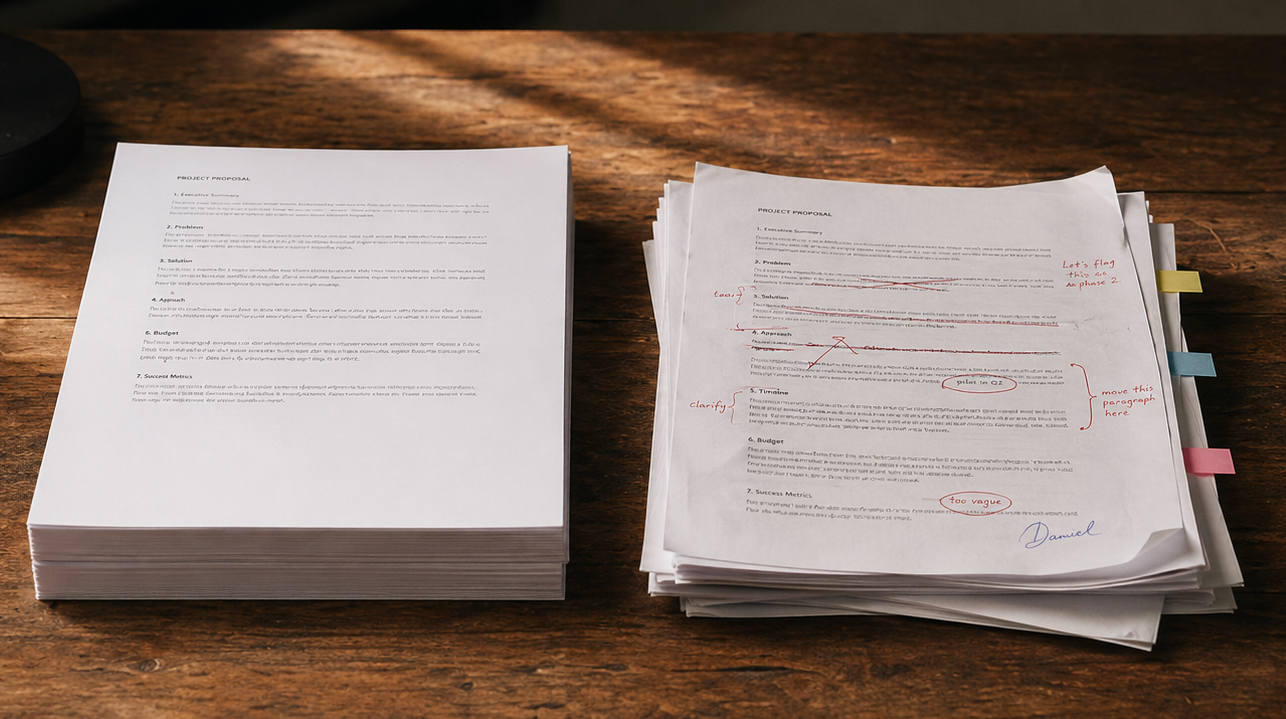
I scrapped the AI version. I wrote the proposal we ended up sending by hand, in the voice we actually use, with one less section than the AI draft and a clearer ask.
It got signed.
Here’s what we built for them after the signature. A python script that takes the daily Flash report, an exhaustive email to every department lead listing every patient movement that day (Patient A left Detox, Patient B admitted to Detox, Patient C discharged from Residential), and translates it into a simple +1 or -1 export feeding a real-time bed board. Vacancies and capacities at a glance. Hours a week saved across leadership. The script does not need a humanizer.
The work that was supposed to win the engagement could not be automated. The work the engagement asked us to do absolutely could.
The line
Here’s what stopped me, and what I want you to hear before you flip the same switch:
Hand-write the inputs, automate the outputs.
Inputs are anything that creates the raw material. The angle. The diagnosis. The opinion. The first read of a contract, the first call with a client, the first rough draft of any piece of public-facing work. Outputs are everything downstream. Reformatting. Distribution. Cleanup. Reminders. Reports. Status updates. Every time something gets passed from one shape to another without a new idea entering the room.
That’s the line. Cross it the wrong way and the thing you build will not be yours.
If you remember nothing else from this piece, remember to stop automating your first drafts. Of anything. Stop right now.
Run an agent on the third draft. Use a workflow for the fifteen-step formatting pass after that, and let AI find the typo, the broken link, the dead phrase. Use it for everything that comes after the thinking.
Just do not let it do the thinking for you. The thinking is the product. The thinking is what you are being paid for, even when you do not realize it.
The people who refuse to automate their own inputs are positioning themselves to be the only humans left with a recognizable point of view in a sea of identical outputs. Their leverage is your willingness to delete yours.
Strip the setup, keep the payoff.
In two years, two classes will have emerged. The first is small. Their work bears their signature in a way no model can replicate. They took the slow road, and the road shaped them, and they are paid accordingly. The second is the great mass. Interchangeable, fast, abundant, indistinguishable. They share a stack and they share a fate.
Pick which class you want to be in. Then act like it.
A craftsman who automates the parts of the process that don’t matter ends up with a sharper craft. A craftsman who automates the parts of the process that do matter ends up with a factory. Both produce output. Only one produces a craftsman.
The mechanical work deserves to handle itself while you sleep. The thinking deserves to keep you up.